
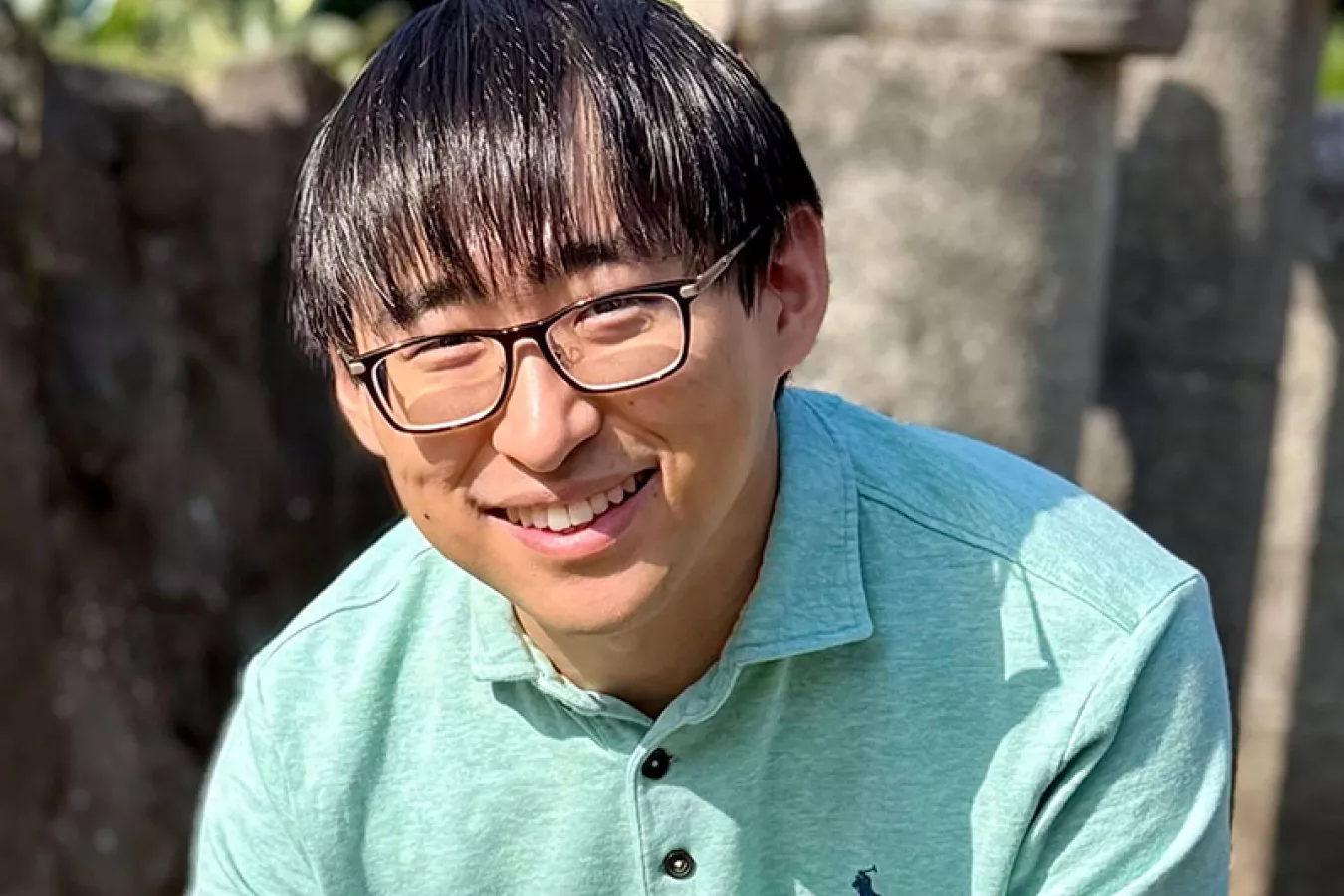
Professor Denny Wu, who will join the Department of Statistics in 2027, has been awarded a five-year Turing AI Global Fellowship to develop new mathematical approaches that could make artificial intelligence (AI) systems more predictable and efficient.
Professor Wu, currently at New York University and the Flatiron Institute, is one of only three researchers to receive a Global Fellowship in the latest round of Turing AI awards announced by UK Research and Innovation (UKRI). The awards form part of a government investment of more than £39 million supporting 20 researchers working to advance AI and its applications.
Despite rapid advances in AI, researchers still have a limited understanding of how large deep learning systems behave as they grow. Training models such as those behind today's AI chatbots requires enormous computing resources, yet improvements to their design and performance often depend on costly trial and error.
Professor Wu aims to address this by developing a predictive mathematical theory of deep learning, allowing researchers to anticipate how AI systems will behave before committing to expensive large-scale training. Central to this is the possibility that much smaller, less costly models could provide reliable insights into the behaviour of their larger counterparts.
His research will investigate how training methods should change as models increase in size, whether new algorithms genuinely accelerate learning, and how the choice of training data affects the way AI systems solve problems. This includes understanding why some models develop reliable reasoning strategies while others learn shortcuts that may fail when faced with unfamiliar situations.
Alongside the theoretical work, the fellowship will support the development of open-source tools and benchmarks to help researchers apply these findings.
Professor Wu said: ‘The field of deep learning moves so quickly that, as a theorist, I sometimes feel like I’m writing the manual for a machine that has already been upgraded twice. This Fellowship gives me the resources to explore foundational questions in depth, turn the answers into tangible impact on how AI is built, and, with luck, finish the manual before the next upgrade.’
Professor Charlotte Deane, Executive Chair of the Engineering and Physical Sciences Research Council (EPSRC), which delivers the fellowships, said: ‘These fellowships will give outstanding researchers the freedom and support to push the boundaries of AI itself, while also applying it in new ways across a wide range of disciplines.’
Professor Jocelyn Monroe, from Oxford's Department of Physics, has also received a Turing AI Pioneer Interdisciplinary Fellowship. Her research will use the search for dark matter to develop more trustworthy AI systems capable of identifying extremely rare events.
How travel patterns can change estimates of an Ebola outbreak
Researchers in the Department of Statistics show how assumptions about the way people travel can substantially change estimates of the size of an emerging disease outbreak.
Alison Etheridge awarded the 2027 Ulf Grenander Prize
The American Mathematical Society has recognised Professor Dame Alison Etheridge for work linking probability theory and population genetics.
Statistics researchers join £1 million programme to investigate immune ageing
Researchers from the University of Oxford's Department of Statistics will help investigate how the immune system changes with age, as part of a new £1 million interdisciplinary research programme funded by the Oxford Martin School.