
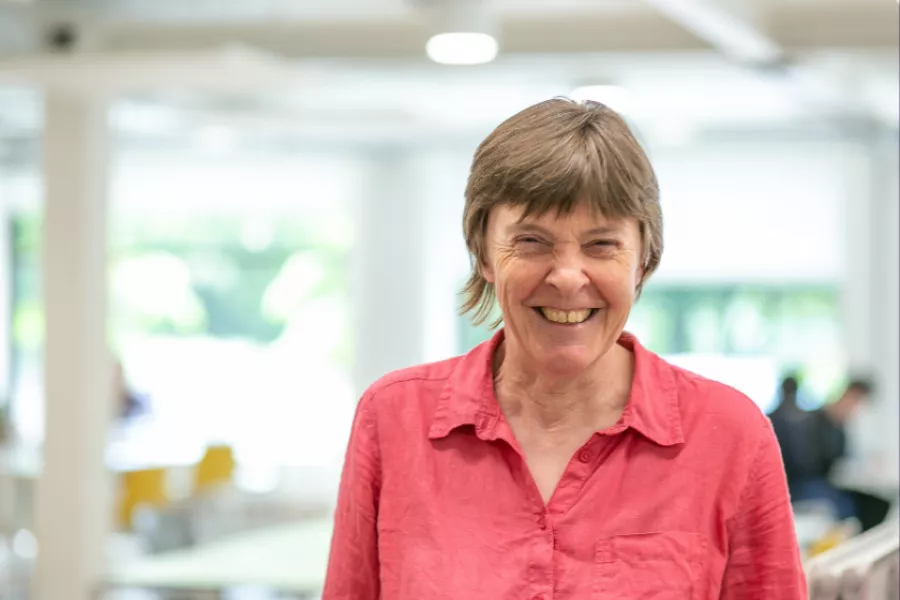
The American Mathematical Society has recognised Professor Dame Alison Etheridge for work linking probability theory and population genetics.
Professor Dame Alison Etheridge, Professor of Probability in the department, has been awarded the 2027 Ulf Grenander Prize in Stochastic Theory and Modeling by the American Mathematical Society (AMS). The prize recognises her pioneering contributions to measure-valued branching processes, population genetics and the interplay between these fields.
Awarded every three years, the prize honours seminal work in probabilistic modelling, statistical inference and related computational algorithms, especially for complex or high-dimensional systems. It was established in 2016 by colleagues of Ulf Grenander, an influential scholar in stochastic processes, abstract inference and pattern theory.
Much of Professor Etheridge’s recent research investigates how the geographical distribution of populations influences genetic variation. One of her notable achievements has been to overcome a longstanding mathematical challenge known as the ‘pain in the torus’, a term coined by geneticist Joe Felsenstein to describe the difficulties of modelling populations in continuous space. Her extensive collaboration with Nick Barton has also advanced understanding of how population structure shapes genetic patterns, combining innovative mathematical models with rigorous approaches from probability theory.
The citation reads: ‘Professor Etheridge’s work is distinguished by exceptional mathematical depth, originality, and breadth. … The impact of these contributions is reflected not only in their influence on probability and population genetics, but also in the vibrant international research community they have inspired.’ It also praises her ‘exceptional leadership in the mathematical sciences’.
Professor Etheridge said: ‘I am deeply honoured to receive the 2027 Ulf Grenander Prize in Stochastic Theory and Modelling. In doing so I’d like to pay tribute to the remarkable collection of students and other collaborators with whom I have worked.’
She described theory and modelling as ‘inextricably intertwined’. She explained that her work with collaborators on infinite-dimensional stochastic processes is rooted in analysis and probability but was motivated by modelling populations evolving across two-dimensional space, and that thinking of these processes as evolving populations has in turn shaped the mathematics.
She added: ‘As I write this, we are seeing a scientific revolution driven by artificial intelligence. There are huge opportunities to leverage this astonishing new tool, but for now, the role of the mathematician in working with domain experts to formulate the right question, to choose the most appropriate assumptions and simplifications, and to interpret and validate results remains undiminished.’
Professor Etheridge holds a joint appointment in the Department of Statistics and the Mathematical Institute, and is a former Head of Department. She is the inaugural President of the Academy for the Mathematical Sciences, a past President of the Institute of Mathematical Statistics, and has held leadership roles at the Royal Society and the Engineering and Physical Sciences Research Council. She is a Fellow of the Royal Society, an International Honorary Member of the American Academy of Arts and Sciences and an International Member of the US National Academy of Sciences, and was appointed Dame Commander of the Order of the British Empire in the 2025 New Year Honours for services to the mathematical sciences.
Statistics researchers join £1 million programme to investigate immune ageing
Researchers from the University of Oxford's Department of Statistics will help investigate how the immune system changes with age, as part of a new £1 million interdisciplinary research programme funded by the Oxford Martin School.
Professor Robin Evans
The Department of Statistics is deeply saddened to announce the death of Professor Robin Evans on 3 November 2026, following an illness.
Oxford × QRT Labs welcomes first DPhil cohort and announces new Director
The University of Oxford has welcomed the first cohort of DPhil students to Oxford × QRT Labs, part of a long-term research initiative between Qube Research & Technologies (QRT) and the University of Oxford, the University of Cambridge and Imperial College London.