
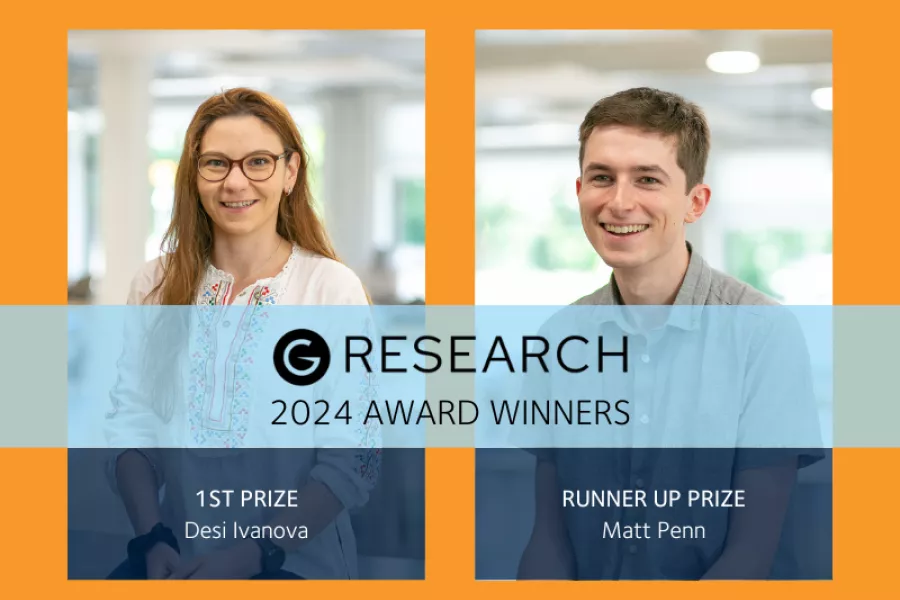
This year, G-Research ran their yearly round of the PhD Prize in Maths and Data Science, where £20,000 of prize funds are available to win for those completing doctoral studies in novel research. We’re excited to announce Desi Ivanova as the first prize winner and Matthew Penn as one of the runner-up winners!
Prize Information
Criteria and Submission Process
To qualify for submission, PhDs were to be in the quantitative areas. This included but was not limited to:
- Quantitative Finance
- Mathematics
- Computer Science
- Statistics
- Physics
- Engineering
- Machine Learning
PhD students were required to submit a 10-page excerpt of their draft dissertation (excluding references) with a CV and covering letter. With the covering letter, entries were to cover a summary of the PhD /research field; how the research is novel; the impact the research has had in its field, and wider quantitative research.
Who are G-Research?
G-Research are a leading quantitative research and technology firm. They hire the brightest minds in the world to tackle some of the biggest questions in finance. They pair this expertise with machine learning, big data, and some of the most advanced technology available to predict movements in financial markets.
The Winners
Automated Data Acquisition via Bayesian Experimental Design
Desi is a final year DPhil candidate at the Department of Statistics through the StatML programme working with Tom Rainforth and Yee Whye Teh. Her research focuses on developing quantitative strategies for adaptive data acquisition, grounded in the information-theoretic framework of Bayesian experimental design.
In today's data-driven world, the quality and relevance of data play a crucial role in guiding decision-making and enabling scientific discoveries. Whilst significant advancements have been made in (supervised) machine learning techniques that make use of data that already exists, the process of actively acquiring high-quality data has often been overlooked. Desi's goal is to bridge this gap by developing strategies that enable more intelligent and efficient data acquisition processes.
Mathematical Biology in the Big Data Era
For Matt’s PhD, he has been looking at applying mathematical and statistical methods to biological problems. Through his research, Matt has explored how to address the lack of suitable tools for academics and industry professionals to process the growing amount of data that is now available.
Although this continuously increasing access to data provides researchers with the opportunity to gather more novel and impactful insights, pre-existing tools do not necessarily have the capability to help in expanding comprehension of the data gathered and/or retrieved for research. Due to the breadth of mathematical biology, Matt has investigated solutions across four different fields for this challenge: epidemic stochasticity, phylogenomic analysis, camera trapping, and optimal vaccination.
In order to maximise the impact of the work, Matt and his collaborators have provided open-source code with each published solution. At this moment of time, eight papers have been written – where Matt has been the first author on seven of the papers. Out of the eight, six have been published and the other two are under review.
Congratulations Desi and Matt on your wins. We hope this award helps you both in your endeavours moving forward, and we’re excited for your bright futures.
Further Information
Related Links
G-Research Announcement: https://www.gresearch.com/news/g-research-2024-phd-prize-winners-university-of-oxford/
Desi R. Ivanova
Website: https://desirivanova.com/
Department profile: https://www.stats.ox.ac.uk/people/desi-r-ivanova
Matthew Penn
Department profile: https://www.stats.ox.ac.uk/people/matthew-penn
Previous G-Research PhD Winners
Chao Zhang (Mathematical Institute) 2023: https://www.gresearch.com/news/2023-phd-prize-winners-university-of-oxford/
Ralph Abboud (Computer Science) 2022: https://www.gresearch.com/news/g-research-phd-prize-in-maths-and-data-science-2022/
Have you got news?
If you have any achievements, announcements, publications, or more you would like to share, please get in touch with Caroline Walsh, the current Department Communications Officer at caroline.walsh@tss.ox.ac.uk or send the news to the department news desk at newsdesk@stats.ox.ac.uk.
Applications for postgraduate study are now open for 2027–28 entry
Postgraduate study at Oxford Statistics offers the chance to work across a broad range of research, from statistical theory and methodology, probability and machine learning to applications in areas including genetics, epidemiology, computational biology, finance and the social sciences.
Tom Rainforth awarded full Professorial title
Tom Rainforth has been awarded the title of Professor of Statistical Machine Learning and, as of 1 September 2026, is also a Fellow of Jesus College.
What does a statistician do for the England football team?
From squad selection to modelling how footballs behave at altitude, statistician Matt Penn explains how data is helping shape the modern game, and why coaches will always matter more than the numbers.