
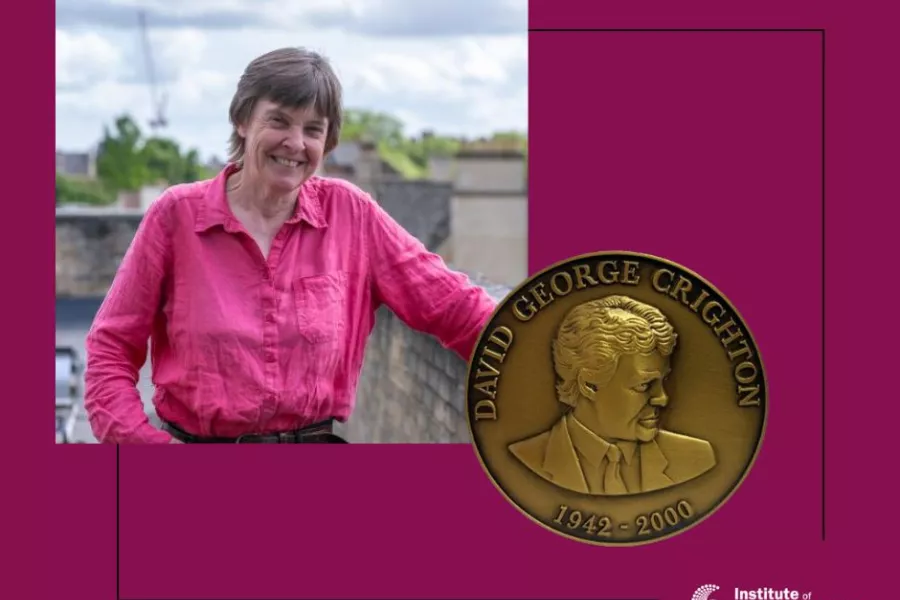
Last Thursday was the IMA-LMS David Crighton Award Lecture and Medal Presentation 2024. Awarded every two years, as the winner of the 2023 IMA-LMS David Crighton Award winner, Professor Alison Etheridge FRS-OBE presented her lecture on Modelling Genes after formally receiving the medal award.
The David Crighton Medal Award
Instituted in 2002 by the Institute of Mathematics and its Applications (IMA) and the London Mathematical Society (LMS) in memory of Professor David George Crighton FRS, the medal award is presented biennially. It celebrates the services of a member of the community to mathematics and to the mathematical community. The person the award is presented to is decided by the Councils of the Institute and Society.
A Leading Researcher and Role Model
Excellence in Mathematics
With this award, Prof. Alison has been recognised for the amazing work she has completed in mathematics and academia. She has a wide and varied career, including working as the Head of the Department of Statistics (University of Oxford) between 2019 – 2022, and acted as the president Institute of Mathematical Statistics (IMS) for 2017-2018.
Due to her high level of achievements, this is not the first award the Professor has received in recognition of her work. In 2017, Etheridge received the Anne Bennett Prize from LMS and was appointed as an Officer of the Order of the British Empire (OBE).
Women Supporting Women
During her on-going career, it has been noted Professor Alison is a great role model for women and has been part of those paving the way for future generation in gender equality in the STEM fields. She has made concerted effort to provide support and encouragement for women in mathematics, whether they’re completing their doctoral studies and/or research, to those who are her junior colleagues. The experience she has gained has helped many women, not only by giving them advice but also providing advice for their partners on how they can be supportive and assist in balancing work and family. Additionally, she has also contributed to how employers can support women within the workplace.
Congratulations, once again, Professor Alison! We're grateful for the outstanding work you've done and continue to do for the mathematics community. Thank you for all your contributions and fantastic leadership.
Related Articles
Department of Statistics (UoO): https://www.stats.ox.ac.uk/news/alison-etheridge-awarded-2023-ima-lms-david-crighton-medal
Mathematical Institute: https://www.maths.ox.ac.uk/node/64981
LMS: https://www.lms.ac.uk/prizes/david-crighton-medal-award-2023
LMS – Good Practice Scheme: https://www.lms.ac.uk/women/gps
IMA: https://ima.org.uk/23443/ima-lms-david-crighton-award-lecture-and-medal-presentation-2024/
Diversity in Mathematics, Statistics, and Data Science: https://committees.parliament.uk/writtenevidence/43008/html/
Distribution of STEM, by gender (2016-2019): Report.
Got News?
If you have any achievements, announcements, publications or more you would like to share, please get in touch with the Department Communications Officer or send the news to the department news desk at newsdesk@stats.ox.ac.uk.
Applications for postgraduate study are now open for 2027–28 entry
Postgraduate study at Oxford Statistics offers the chance to work across a broad range of research, from statistical theory and methodology, probability and machine learning to applications in areas including genetics, epidemiology, computational biology, finance and the social sciences.
Tom Rainforth awarded full Professorial title
Tom Rainforth has been awarded the title of Professor of Statistical Machine Learning and, as of 1 September 2026, is also a Fellow of Jesus College.
What does a statistician do for the England football team?
From squad selection to modelling how footballs behave at altitude, statistician Matt Penn explains how data is helping shape the modern game, and why coaches will always matter more than the numbers.