
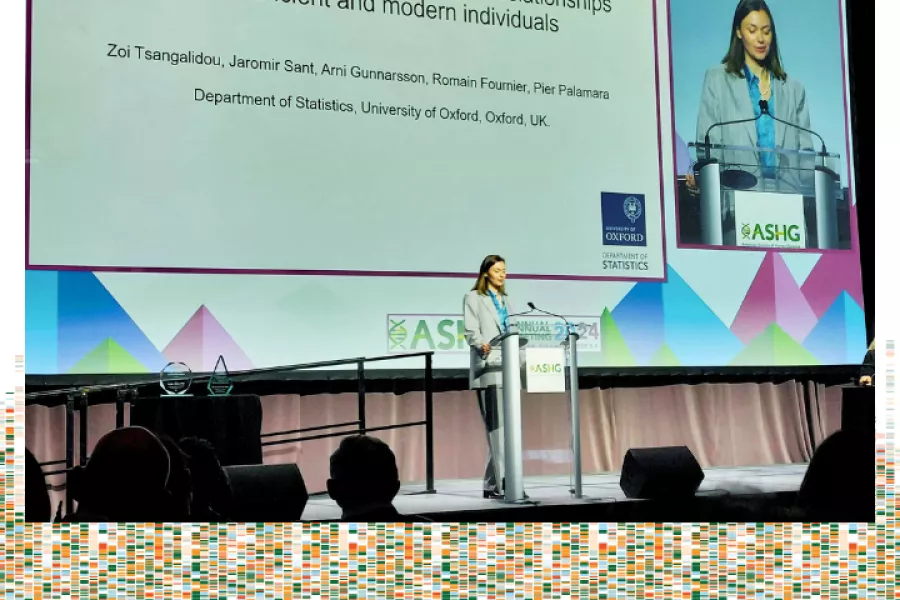
Zoi Tsangalidou, a final-year DPhil student in the Department of Statistics, has won the 2024 American Society of Human Genetics (ASHG) Trainee Research Excellence Pre-Doctoral Award. She is one of 6 winners out of 900+ award candidates! Zoi’s abstract was also selected as a plenary talk – it was one of the top 15 out of ~4000 submitted abstracts (including non-trainee submissions).
Congratulations, Zoi!
Plenary Talk
On the 8th November, Zoi presented her plenary talk, it was titled: 'Inference of genome-wide genealogical relationships between ancient and modern individuals'. It covered the use of ancient DNA from the Allen Ancient DNA Resource dataset alongside large biobanks such as the UK Biobank, as well as the newly developed method, ThreaDNA. This method was created for the study of genome-wide genealogical relationships between individuals and their evolution over time.
Zoi’s plenary abstract can be found in the ASHG 2024 Annual Meeting Plenary Abstracts document and you can contact her if you wish to learn more about her research.
The Award
Formerly known as the Charles J. Epstein Trainee Research Awards, the Trainee Research Excellence Award is a merit-based award for pre- and post-doctoral trainees. Awards prizes range between $750 – $2,000. 18 finalists (9 pre-doctoral and 9 post-doctoral), who are selected based on their submitted abstracts, are asked to give a 3-minute poster presentation of their work to a panel of judges who then select the final 6 winners.
Abstract submissions are made before the end of late spring/early summer (~May), with finalist announcements made in late summer. Winners are then selected at the annual meeting following the poster competition and collect their awards at the annual meeting.
Oxford × QRT Labs welcomes first DPhil cohort and announces new Director
The University of Oxford has welcomed the first cohort of DPhil students to Oxford × QRT Labs, part of a long-term research initiative between Qube Research & Technologies (QRT) and the University of Oxford, the University of Cambridge and Imperial College London.
Applications for postgraduate study are now open for 2027–28 entry
Postgraduate study at Oxford Statistics offers the chance to work across a broad range of research, from statistical theory and methodology, probability and machine learning to applications in areas including genetics, epidemiology, computational biology, finance and the social sciences.
Tom Rainforth awarded full Professorial title
Tom Rainforth has been awarded the title of Professor of Statistical Machine Learning and, as of 1 September 2026, is also a Fellow of Jesus College.