
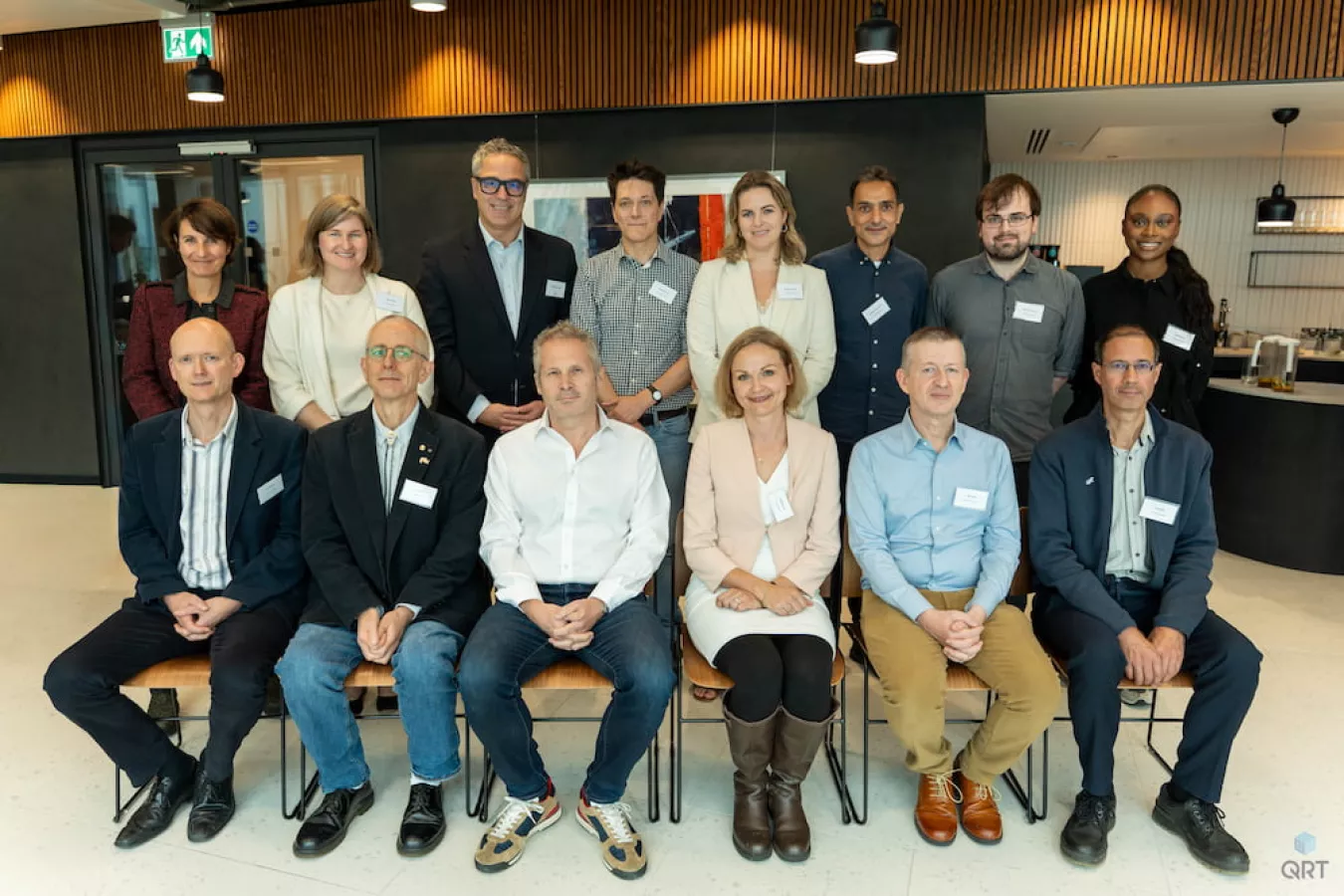
The University of Oxford has welcomed the first cohort of DPhil students to Oxford × QRT Labs, part of a long-term research initiative between Qube Research & Technologies (QRT) and the University of Oxford, the University of Cambridge and Imperial College London.
Four DPhil students make up Oxford × QRT Labs’ first cohort, with one researcher based in each of the Mathematical Institute, Department of Statistics, Department of Engineering Science and Department of Computer Science.
The launch also marks the appointment of Professor Blanka Horvath as Director of Oxford × QRT Labs.
Oxford × QRT Labs forms part of a wider research network bringing together early-career researchers, academics and QRT’s research and technology community. The initiative is designed to support fundamental research while creating opportunities for researchers to exchange ideas across disciplines and institutions and to engage with industry and the wider scientific and technological community.
Across Oxford, Cambridge and Imperial, the first QRT Labs cohort comprises 13 early-career researchers working across mathematics, statistics, computer science and engineering. Their research spans areas including AI and its mathematical foundations, intelligent systems, decision-making under uncertainty, scientific and high-performance computing, optimisation, and advanced mathematical and statistical modelling.
Professor Blanka Horvath, Director of Oxford × QRT Labs, said:
'It is a privilege to lead Oxford × QRT Labs at the beginning of this ambitious partnership. Oxford’s particular strength lies in the depth of expertise across mathematics, statistics, computer science and engineering. My ambition is to make this more than a collection of individual research projects: to build a genuinely connected community in which doctoral and postdoctoral researchers can pursue fundamental questions, exchange ideas across disciplinary boundaries, and benefit from sustained engagement with QRT’s researchers. I am especially delighted to welcome our first four DPhil students and look forward to building the Lab with them.'
The first cohort forms part of QRT’s longer-term commitment to supporting early-career research. Across the three partner universities, the initiative is expected to support more than 70 doctoral students and postdoctoral researchers/research fellows.
Researchers will also have opportunities to connect across the wider QRT Labs network through seminars, events and an annual conference, encouraging exchange between disciplines, institutions and QRT’s research community.
The first cohort and the developing QRT Labs community were celebrated at a launch event at QRT’s headquarters in London on 12 October, bringing together researchers, academics and university representatives from Oxford, Cambridge and Imperial.
Professor Denny Wu awarded major AI fellowship to advance mathematical foundations of deep learning
Professor Denny Wu, who will join the Department of Statistics in 2027, has been awarded a five-year Turing AI Global Fellowship to develop new mathematical approaches that could make AI systems more predictable and efficient.
How travel patterns can change estimates of an Ebola outbreak
Researchers in the Department of Statistics show how assumptions about the way people travel can substantially change estimates of the size of an emerging disease outbreak.
Alison Etheridge awarded the 2027 Ulf Grenander Prize
The American Mathematical Society has recognised Professor Dame Alison Etheridge for work linking probability theory and population genetics.