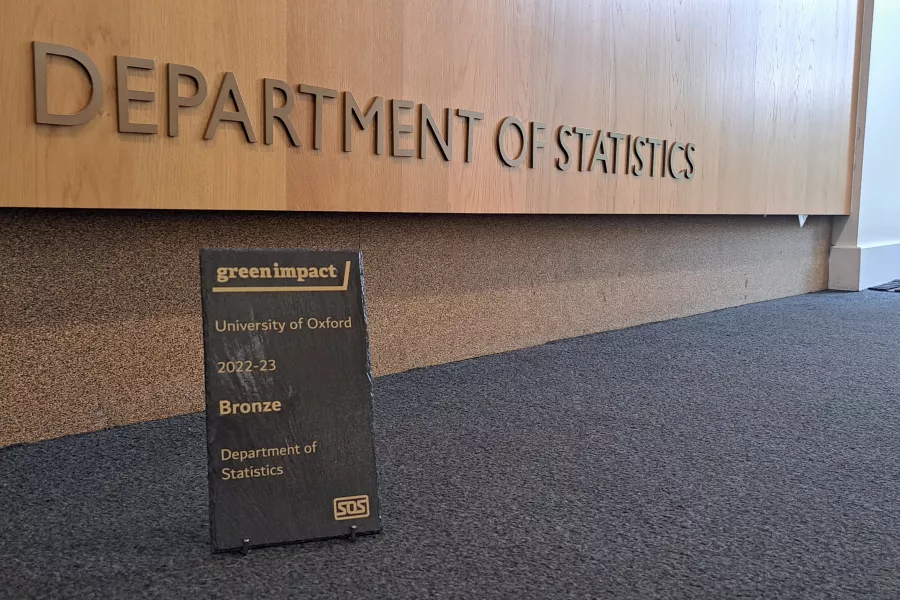
The Department of Statistics has been awarded a Bronze Green Impact award, acknowledging the work in our department towards greater sustainability. Green Impact is a programme designed to support environmentally and socially sustainable practice within organisations.
These awards were presented as part of the Vice Chancellor’s Awards for Environmental Sustainability 2023. Vice-Chancellor Professor Irene Tracey presented the awards at a ceremony in the Divinity School of the Bodleian Library, along with colleagues from across the University. Taken together, these Awards highlight the significant contributions being made across the University community towards meeting our strategic environmental goals of net zero carbon and biodiversity net gain by 2035.
The full list of winners across the University and colleges can be found on the University’s Sustainability webpages, where you can also download the Awards brochure to learn more about the winners and see the winning photographs from the Sustainability Photographer of the Year competition.
Applications for postgraduate study are now open for 2027–28 entry
Postgraduate study at Oxford Statistics offers the chance to work across a broad range of research, from statistical theory and methodology, probability and machine learning to applications in areas including genetics, epidemiology, computational biology, finance and the social sciences.
Tom Rainforth awarded full Professorial title
Tom Rainforth has been awarded the title of Professor of Statistical Machine Learning and, as of 1 September 2026, is also a Fellow of Jesus College.
What does a statistician do for the England football team?
From squad selection to modelling how footballs behave at altitude, statistician Matt Penn explains how data is helping shape the modern game, and why coaches will always matter more than the numbers.