
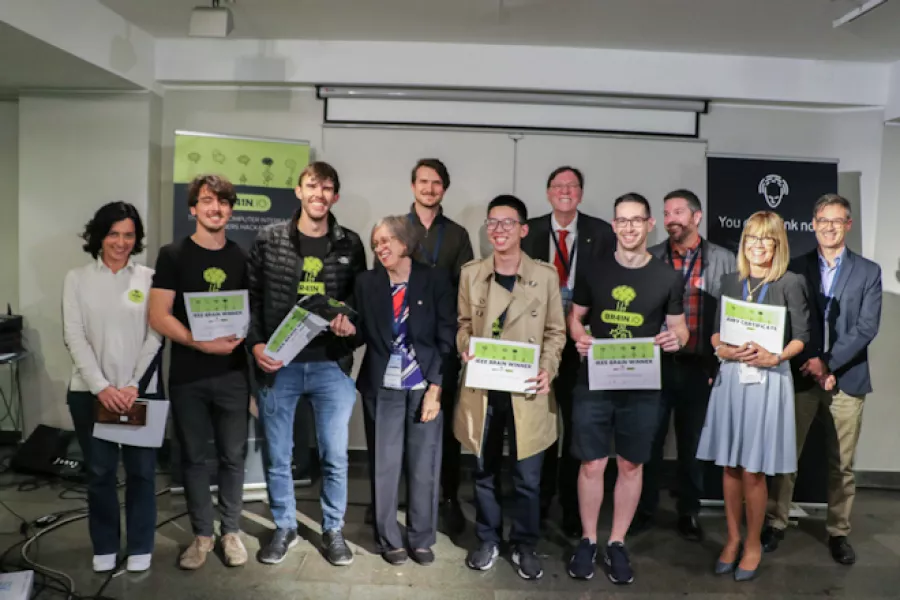
Our current doctoral student James Wilsenach, our former doctoral student Michael Golden, as well as Oxford student Moritz Moeller and Li Wei of Tongji University, China, formed team Unibrowser to take part in, and win, the IEEE BR41N.IO Designer's Hackathon in which teams design and present a novel application for a wearable Brain-Computer Interface known as the Unicorn, produced and sponsored by g.tec Neurotechnology, Austria.
Team Unibrowser presented a navigation tool designed to assist users in finding what they are looking by posing a series of increasingly specific questions with mentally inputted answers from the user. The task was presented in the form of a game in which our software tries to determine a mentally selected country, selecting questions based on a Bayesian update system.
Applications for postgraduate study are now open for 2027–28 entry
Postgraduate study at Oxford Statistics offers the chance to work across a broad range of research, from statistical theory and methodology, probability and machine learning to applications in areas including genetics, epidemiology, computational biology, finance and the social sciences.
Tom Rainforth awarded full Professorial title
Tom Rainforth has been awarded the title of Professor of Statistical Machine Learning and, as of 1 September 2026, is also a Fellow of Jesus College.
What does a statistician do for the England football team?
From squad selection to modelling how footballs behave at altitude, statistician Matt Penn explains how data is helping shape the modern game, and why coaches will always matter more than the numbers.