
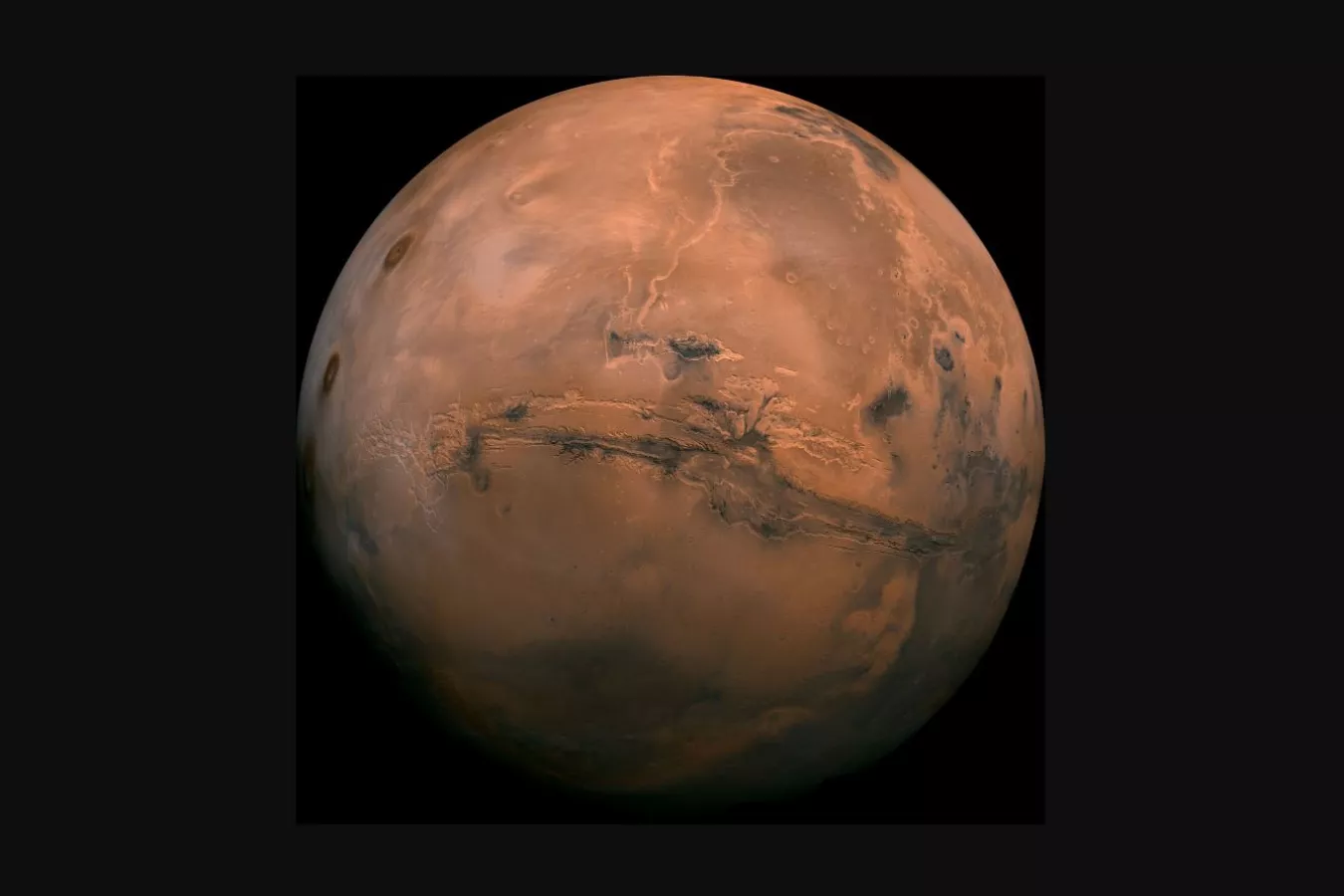
Researchers from the Departments of Earth Science and Statistics have found evidence that Mars once hosted enormous, Earth-like magmatic systems deep below its surface – even though the planet lacks the plate tectonics long considered essential for this kind of geological complexity. The findings, published in Nature Astronomy, open up new possibilities for how rocky planets become habitable.
Mars is often described as a 'stagnant lid' planet: unlike Earth, its surface isn't broken up into moving tectonic plates. Since plate tectonics drives volcanism, recycling and continent-building on Earth, many scientists had assumed Mars simply lacked the conditions needed to generate similarly complex crust. This new study challenges that assumption, suggesting Mars could instead have produced highly evolved crust through intense internal recycling.
The study drew on data collected by NASA's InSight mission, which recorded seismic waves generated by meteoroid impacts and marsquakes – the Martian equivalent of earthquakes. Researchers from Oxford's Departments of Earth Sciences and Statistics used these recordings to probe a mysterious boundary roughly 24 kilometres beneath the Martian surface. The boundary itself had been identified in earlier studies, but its nature remained unknown. To test whether it marked a transition between two different rock types, the Oxford team compared hundreds of possible rock compositions against the seismic data using thermodynamic modelling combined with Bayesian statistical methods. By factoring in uncertainty in both the seismic measurements and the range of possible rock compositions, this statistical approach allowed the team to find the explanation best supported by the evidence.
The results showed that only 'ultramafic' rocks (rich in iron and magnesium, but low in silica) consistently matched the physical properties below the 24-km boundary, while the properties above it aligned more closely with 'mafic' rocks (containing a higher proportion of silica).
According to the researchers, this buried layer likely formed as molten rock pooled deep underground and gradually separated into distinct materials – leaving a thick residue of dense crystals at the base of the crust while lighter, more evolved melts rose towards the surface. A similar process occurs on Earth beneath volcanic arcs, where it is linked to continent formation.
Lead author Dr Tobermory Mackay-Champion, Department of Earth Sciences, University of Oxford at the time of the study, now at the University of Bristol, said: ‘We've traditionally assumed that volcanism on Mars was relatively simple compared to that on Earth. But this discovery suggests the planet could sustain massive, long-lived magmatic systems capable of evolving and reprocessing molten rock throughout the crust. Because these systems are known to generate large metal deposits, Mars may hold significantly more near-surface mineral wealth than previously recognised – boosting its potential for future mining, crewed missions and eventually, permanent settlements.’
Co-author Dr Max Anderson Loake, Department of Statistics, University of Oxford at the time of the study, said: ‘The likelihoods were derived by comparing the seismic velocities recorded by InSight to the velocities we would expect to see under each candidate rock composition at the elevated temperatures and pressures expected beneath the Martian surface. A key challenge was ensuring the analysis accounted for both uncertainty in the seismic measurements and the wide range of possible rock compositions. Bayesian methods were particularly well-suited to this problem because they let us propagate these uncertainties into a posterior probability for each layer, rather than giving a single best-fit answer.’
According to the study, this layer may stretch sideways for hundreds, or even thousands, of kilometres across Mars' northern hemisphere – pointing to enormous, interconnected magmatic systems rather than a scattering of isolated volcanoes. This process, known as 'transcrustal magmatism', was previously believed to occur only on Earth.
These geological processes are closely tied to how planets develop atmospheres, oceans and potentially habitable conditions. On Earth, for example, geological recycling helps regulate climate and sustains the long-term cycling of water and other volatile elements. Plate tectonics has often been seen as essential to creating these conditions, but the new findings suggest that Earth-style tectonics may not be a prerequisite for building complex crusts – or for sustaining the conditions that support life.
Co-author Associate Professor Jon Wade, Department of Earth Sciences, University of Oxford, said: ‘One of the big questions in planetary science is whether Earth is unique. If Mars could develop this kind of complex crust without plate tectonics, then maybe the conditions needed for habitability can emerge on more planets than we realised, including those previously dismissed based on size or their apparent lack of tectonic activity.’
The research builds on seismic data from NASA's InSight mission, which placed the first seismometer on Mars in 2018 and gave scientists an unprecedented view of the planet's interior.
The study was led by researchers from Oxford University's Department of Earth Sciences, in collaboration with the University of Bristol and the University of Oxford's Department of Statistics.
The paper, 'Seismic evidence for a melt-depleted lower crust and transcrustal magmatism on Mars', has been published in Nature Astronomy.
Applications for postgraduate study are now open for 2027–28 entry
Postgraduate study at Oxford Statistics offers the chance to work across a broad range of research, from statistical theory and methodology, probability and machine learning to applications in areas including genetics, epidemiology, computational biology, finance and the social sciences.
Tom Rainforth awarded full Professorial title
Tom Rainforth has been awarded the title of Professor of Statistical Machine Learning and, as of 1 September 2026, is also a Fellow of Jesus College.
What does a statistician do for the England football team?
From squad selection to modelling how footballs behave at altitude, statistician Matt Penn explains how data is helping shape the modern game, and why coaches will always matter more than the numbers.