
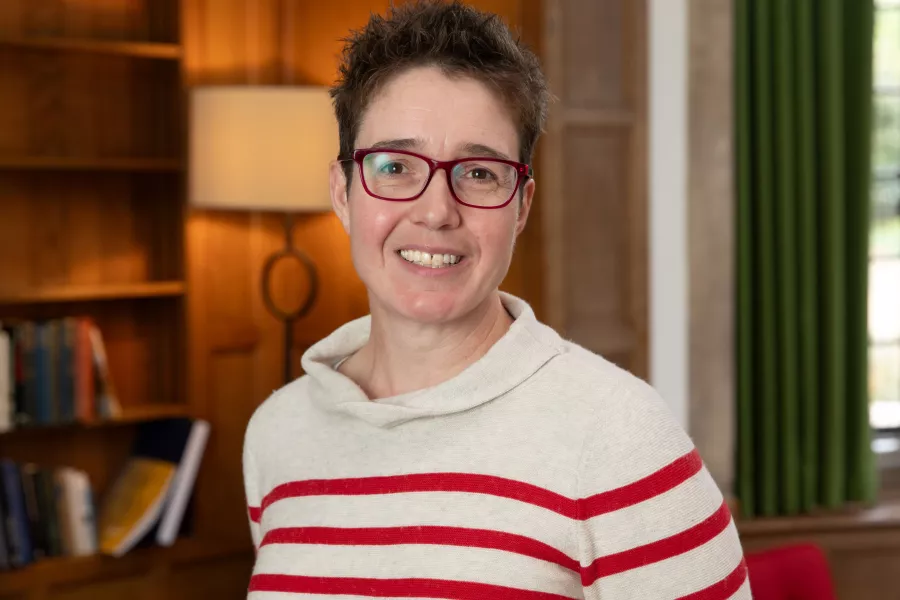
Professor Charlotte Deane MBE, Professor of Structural Bioinformatics in Oxford’s Department of Statistics, has today been announced among the new Fellows of the Royal Society.
Professor Deane, who leads the Oxford Protein Informatics Group (OPIG), is recognised for her work bringing together statistics, artificial intelligence and biology. Her research develops computational methods to understand and predict protein evolution, interaction, structure and function, with applications across immunoinformatics, protein structure and small molecule drug discovery.
Under her leadership, the group has developed algorithms, tools and databases that are openly available to the scientific community and widely used across academia and industry. These resources form part of pharmaceutical drug discovery pipelines, supporting research into proteins, antibodies, drugs and their interactions.
Professor Deane said: ‘I really appreciate this honour. I know that this would never have happened without the brilliant and inspiring students, postdocs and colleagues who I have worked with, and I am very grateful to them.’
Professor Frank Windmeijer, Head of the Department of Statistics, said: ‘We are delighted that Charlotte has been elected a Fellow of the Royal Society. This is a well-deserved honour, recognising her outstanding work bringing together statistics, artificial intelligence and biology, alongside her leadership across science and public life. Charlotte has made an enormous contribution to the Department, and we are very proud to see her work recognised in this way.'
Alongside her research at Oxford, Professor Deane is Executive Chair of the Engineering and Physical Sciences Research Council. During the COVID-19 pandemic, her public service included advising the UK Government on the Scientific Advisory Group for Emergencies (SAGE) and serving as UK Research and Innovation’s COVID-19 Response Director. She was appointed MBE in the 2022 Birthday Honours for services to COVID-19 research.
The Royal Society’s President, Sir Paul Nurse, said: ‘I am delighted to welcome this newest group of exceptional scientists to the Fellowship of the Royal Society.
‘Their contributions reflect the highest standards of scientific endeavour. Whether advancing our understanding of vaccines or exploring the transformative potential of mathematics and computation, their work exemplifies the enduring value of curiosity, creativity and rigorous inquiry.’
Founded in 1660, the Royal Society is the UK’s national academy of sciences and the oldest scientific academy in continuous existence. Its Fellowship has included figures such as Isaac Newton, Charles Darwin, Albert Einstein, Dorothy Hodgkin, Alan Turing and Stephen Hawking.
Professor Deane is one of twelve Oxford academics elected to the Fellowship this year.
Applications for postgraduate study are now open for 2027–28 entry
Postgraduate study at Oxford Statistics offers the chance to work across a broad range of research, from statistical theory and methodology, probability and machine learning to applications in areas including genetics, epidemiology, computational biology, finance and the social sciences.
Tom Rainforth awarded full Professorial title
Tom Rainforth has been awarded the title of Professor of Statistical Machine Learning and, as of 1 September 2026, is also a Fellow of Jesus College.
What does a statistician do for the England football team?
From squad selection to modelling how footballs behave at altitude, statistician Matt Penn explains how data is helping shape the modern game, and why coaches will always matter more than the numbers.