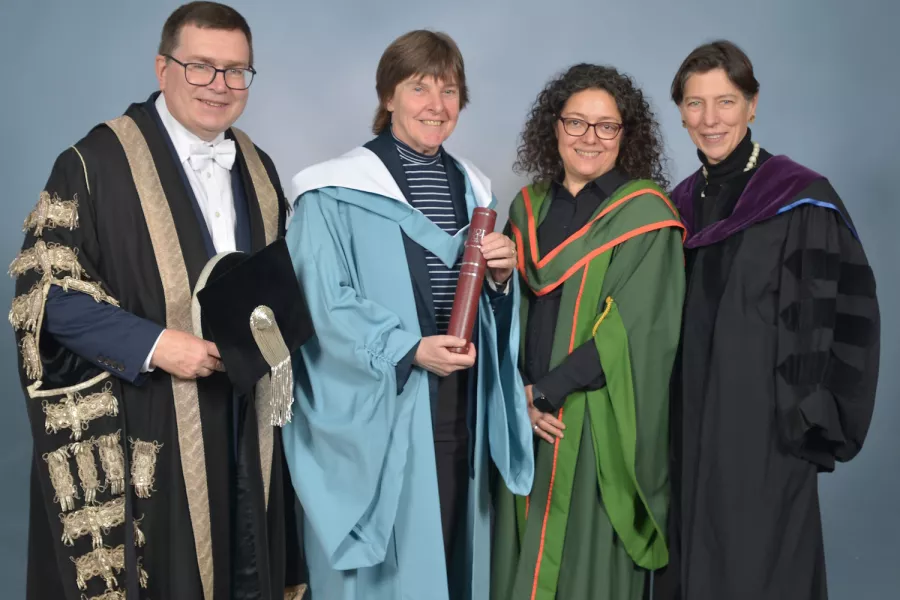
Professor Dame Alison Etheridge, Professor of Probability in the Department of Statistics, has been recognised with a Doctor of Science (DSc) from Heriot-Watt University as part of its 2025 winter graduation programme.
Professor Etheridge was cited for her influential contributions to probability theory and population genetics, together with her leadership across the mathematical sciences. The award acknowledges the depth of her research and her longstanding commitment to advancing the discipline.
Over the course of her career at Oxford, Professor Etheridge has held roles including Deputy Head of the MPLS Division and, from 2019 to 2022, Head of the Department of Statistics. She currently serves as President of the Academy for the Mathematical Sciences, the first person elected to the role. Her research spans infinite-dimensional stochastic processes and mathematical problems arising in population genetics. Earlier this year, she was appointed Dame Commander of the British Empire (DBE) for services to the mathematical sciences.
Professor Etheridge was among four honorary degree recipients, alongside chemical engineer Professor Jinghai Li, biotechnologist Dr Martin Mackay, and Tom Hendren, known for his work in international business.
Professor Richard A. Williams, Principal and Vice-Chancellor of Heriot-Watt University, said:
‘Their remarkable achievements – spanning mathematics, chemical engineering, biotechnology and international business – demonstrate how deep expertise and creative thinking can change industries and improve lives around the world. We are proud to recognise their contributions and to celebrate them as part of our global community.’
Left to right in the photo: Professor Richard A. Williams, Principal and Vice-Chancellor of Heriot-Watt University with Alison Etheridge, Professor Sara Lombardo, Executive Dean of the School of Mathematical & Computer Sciences and Professor Beatrice Pelloni, Professor of Mathematics in the School of Mathematical & Computer Sciences.
Applications for postgraduate study are now open for 2027–28 entry
Postgraduate study at Oxford Statistics offers the chance to work across a broad range of research, from statistical theory and methodology, probability and machine learning to applications in areas including genetics, epidemiology, computational biology, finance and the social sciences.
Tom Rainforth awarded full Professorial title
Tom Rainforth has been awarded the title of Professor of Statistical Machine Learning and, as of 1 September 2026, is also a Fellow of Jesus College.
What does a statistician do for the England football team?
From squad selection to modelling how footballs behave at altitude, statistician Matt Penn explains how data is helping shape the modern game, and why coaches will always matter more than the numbers.