
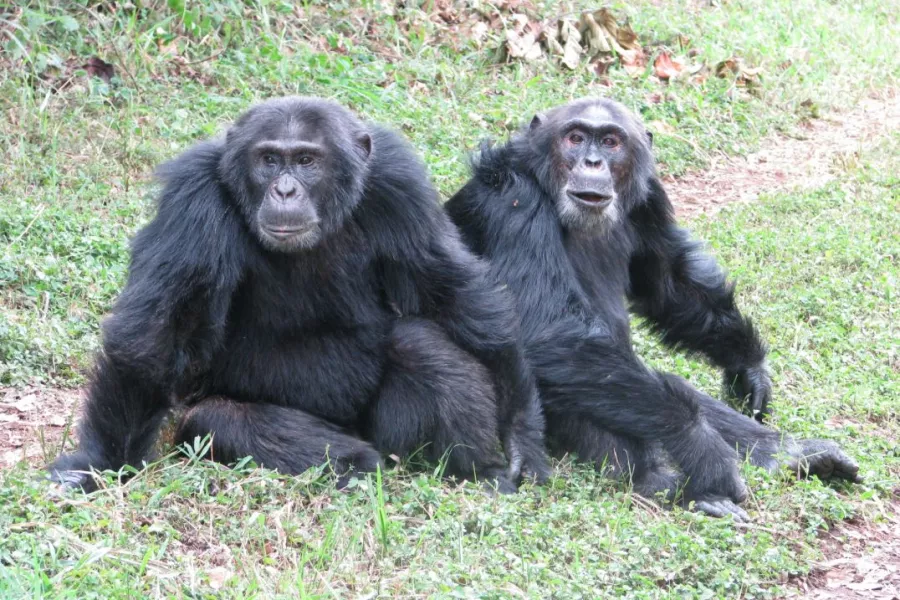
A collaborative study led by researchers at the University of Texas at Austin, published this week in Science, reports the first clearly documented permanent split of a wild chimpanzee community and the intergroup aggression that followed.
Professor Gesine Reinert from Oxford's Department of Statistics, Yixuan He (Arizona State University) and Mihai Cucuringu (UCLA) provided statistical methods to establish when the split occurred and how it had developed.
Working from field records, noting which chimps were spending time together, grooming each other, and going on patrols together, they developed a network time series approach that combined those different signals into a single picture of how the social structure was changing year by year, identifying distinct communities at each time step and tracking individuals who maintained ties across the emerging divide.
‘While not every chimp was observed during every observation period, the statistical approach made it possible to quantify the change in social structure,’ said Professor Reinert.
The research draws on nearly 30 years of field observations of the Ngogo chimpanzee community in Kibale National Park, Uganda, a group of more than 200 individuals monitored continuously since 1995.
For the first two decades of study, the community functioned as a single social group, with individuals moving between temporary subgroups and maintaining ties across the whole population. From around 2015, the data showed a progressive reduction in interactions between two clusters, referred to as the Western and Central groups. By 2018 the two had ceased to associate, occupy overlapping ranges, or mate across group boundaries. Between 2018 and 2024, the team recorded attacks on seven adult males and 17 infants, some witnessed directly and others pieced together from physical evidence. The conflict is ongoing.
Permanent splits of this kind are rare in chimpanzees, with genetic data suggesting they occur roughly once every 500 years. A split was reported at Gombe, Tanzania in the 1970s during Jane Goodall's study, but that that case differs in one important respect: the chimpanzees there were provided with food by researchers. Goodall installed a banana feeding station which may have brought more than one community of chimpanzees together. In contrast, the Ngogo community was not provisioned, and the observation record spanning before, during and after the split makes it among the most thoroughly documented examples to date.
'What's especially striking is that the chimpanzees are killing former group members,' said Dr Aaron Sandel of the University of Texas at Austin, the study's lead author. 'The new group identities are overriding cooperative relationships that had existed for years.'
The authors note that the Ngogo case shares some features with the earlier Gombe split, including the deaths of several males who had maintained ties between the clusters and a change in the alpha male, though the relative contribution of each factor remains unclear. Because chimpanzees do not have language, ethnicity or shared ideology, the authors suggest the findings bear on debates about what drives collective conflict. Shifting social relationships, they propose, may be sufficient to produce group-level polarisation and violence.
The research team is continuing to document and analyse the ongoing conflict. It is the first recorded instance of lethal violence between animals who were once members of the same social group, a behaviour previously thought unique to humans.
The paper 'Lethal conflict after group fission in wild chimpanzees' by A. A. Sandel, Y. He, J. Ren et al. is published in Science, Vol. 392, 9 April 2026.
The network analysis code and dataset are publicly available at Zenodo (doi:10.5281/zenodo.19210783).
Photo credit: John Mitain
Applications for postgraduate study are now open for 2027–28 entry
Postgraduate study at Oxford Statistics offers the chance to work across a broad range of research, from statistical theory and methodology, probability and machine learning to applications in areas including genetics, epidemiology, computational biology, finance and the social sciences.
Tom Rainforth awarded full Professorial title
Tom Rainforth has been awarded the title of Professor of Statistical Machine Learning and, as of 1 September 2026, is also a Fellow of Jesus College.
What does a statistician do for the England football team?
From squad selection to modelling how footballs behave at altitude, statistician Matt Penn explains how data is helping shape the modern game, and why coaches will always matter more than the numbers.