The department will be collaborating with the Nuffield Department of Medicine (NDM) and GSK – a global biopharma company, to draw upon Oxford’s expertise in biostatistics and artificial intelligence (AI). The expertise will be used for the development of new tools and methods for medical and biopharmaceutical research.
The partnership will be based in the Department of Statistics and NDM. It will develop new methodologies to give researchers access to patterns and associations from extensive quantities of complicated and multi-layered health data. These patterns and associations have been inaccessible without the new tools and methods under development. With this access, the data and the analysis that follows will benefit clinical research by feeding into the improvement of design, decision-making, and efficiency of making discoveries to improve outcomes for patients.
In addition to the newly accessible patterns and associations, other methodologies and insights to be generated by the research will be applicable to several different areas of health and medical science. They will use data sets with public access to aid in the development of open-source tools and resources.
Joint Leadership
The programme of research will be co-led by Professor Chris Holmes and Dr. Nicky Best of GSK.
Professor Holmes is a professor of Biostatistics in Genomics in the Department of Statistics and the Big Data Institute (BDI).
Dr. Nicky Best is the VP and Head of the Statistical and Data Science Innovation Hub at GSK.
First Project Foci
At this moment of time, the initial areas of purpose for the primary projects are under evaluation by Oxford and GSK. They are aiming to start projects in early 2025.
Regardless of the focus chosen for the projects, the collaboration (and its method of approach) will be using multidisciplinary teams of scientists from Oxford and GSK. This is in line with the Oxford-GSK Institute of Molecular and Computational Medicine (IMCM) formed in 2022. The IMCM first prioritised the evaluation and integration of new approaches in genetics, proteomics, and digital pathology to understand detailed patterns of disease which vary amongst individuals. Now it has a research focus on neurological diseases, like Alzheimer’s and Parkinson’s Disease.
We look forward to the partnership and the exciting discoveries it will bring.
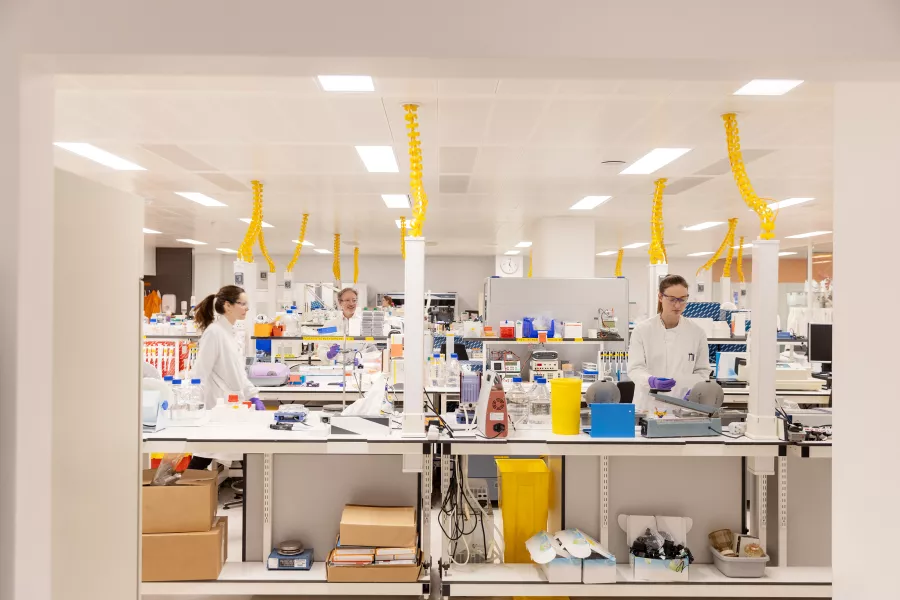
Image - Research and Development Laboratory, was taken from the GSK media library.
Applications for postgraduate study are now open for 2027–28 entry
Postgraduate study at Oxford Statistics offers the chance to work across a broad range of research, from statistical theory and methodology, probability and machine learning to applications in areas including genetics, epidemiology, computational biology, finance and the social sciences.
Tom Rainforth awarded full Professorial title
Tom Rainforth has been awarded the title of Professor of Statistical Machine Learning and, as of 1 September 2026, is also a Fellow of Jesus College.
What does a statistician do for the England football team?
From squad selection to modelling how footballs behave at altitude, statistician Matt Penn explains how data is helping shape the modern game, and why coaches will always matter more than the numbers.