
This week is Neurodiversity Celebration Week, a worldwide initiative to challenge stereotypes as well as misconceptions of neurological differences, originally founded in 2018 by Siena Castellon.
Throughout the week, there are events being held by the Neurodiversity Celebration Week organisation. For the department, we are holding our own activities for department members on Thursday to celebrate the week and rise awareness of the campaign. Keep an eye on our communication channels to find out what we’ll be doing.
Creating a safe space for those who are neurodiverse is an important part of our values as a department within the University of Oxford. There are a number of resources available for staff and students within the university: we highly encourage you to use these resources when ever you think you may need help. To assist with this, we have gathered some of the resources available for you in this post.
Resources
Neurodiversity Celebration Week website: https://www.neurodiversityweek.com/
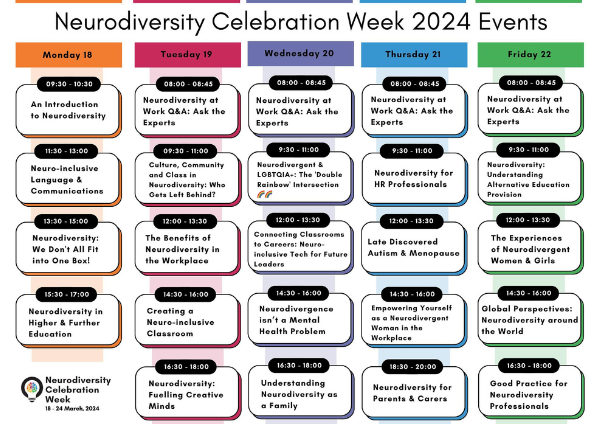
Events Schedule organised by Neurodiversity Celebration Week:
Neurodiversity at Oxford
Website: https://neurodiversityoxford.web.ox.ac.uk/
Email: neurodiversityoxford@gmail.com
Facebook: https://www.facebook.com/Neurodiversity-at-Oxford-113713961087462
Instagram: https://www.instagram.com/neurodiverseox/
Twitter: https://twitter.com/NeurodiverseOx
Department Resources
Equality, Diversity, and Inclusion: https://www.stats.ox.ac.uk/equality-diversity-and-inclusion
Other Resources
Support for neurodivergent staff: https://edu.admin.ox.ac.uk/support-for-neurodivergent-staff
Support for neurodivergent students, the Disability Advisory Service: https://www.ox.ac.uk/students/welfare/disability?wssl=1
Support for visitors: https://edu.admin.ox.ac.uk/disabled-visitors
MPLS Networks and Support: https://www.mpls.ox.ac.uk/equality-diversity-and-inclusion-in-mpls/disability-and-neurodivergence-in-mpls/disability-and-neurodivergence-networks-and-support
Applications for postgraduate study are now open for 2027–28 entry
Postgraduate study at Oxford Statistics offers the chance to work across a broad range of research, from statistical theory and methodology, probability and machine learning to applications in areas including genetics, epidemiology, computational biology, finance and the social sciences.
Tom Rainforth awarded full Professorial title
Tom Rainforth has been awarded the title of Professor of Statistical Machine Learning and, as of 1 September 2026, is also a Fellow of Jesus College.
What does a statistician do for the England football team?
From squad selection to modelling how footballs behave at altitude, statistician Matt Penn explains how data is helping shape the modern game, and why coaches will always matter more than the numbers.