
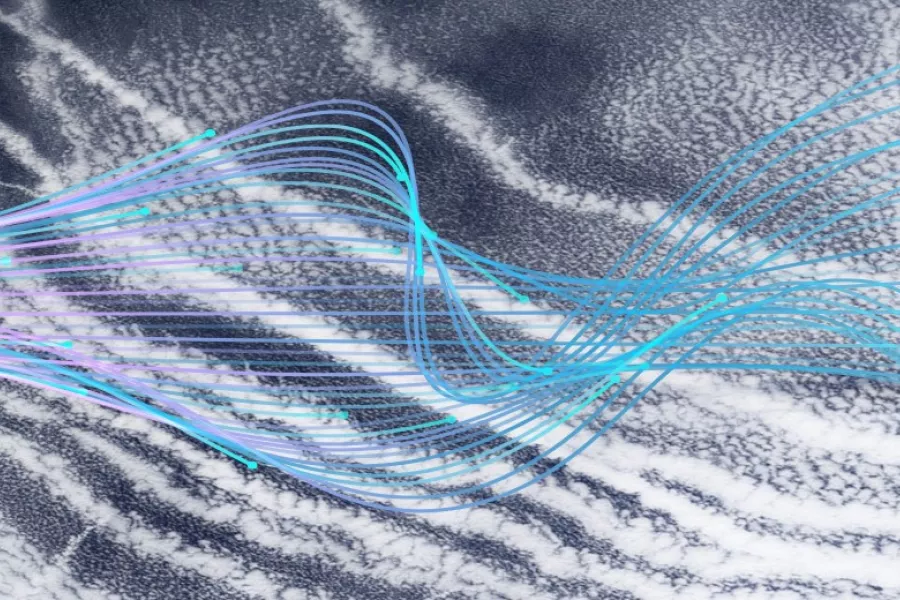
Backed by over £15 million funding, the University of Oxford is establishing a new Centre for Doctoral Training (CDT) that will combine the university’s strengths in artificial intelligence (AI), machine learning, Big Data, and environmental sciences. Over an initial eight years, The UKRI AI Centre for Doctoral Training in AI for the Environment (The Intelligent Earth Centre) will train almost 100 PhD students to develop and apply cutting-edge AI technologies to tackle urgent environmental crises.
The Centre involves the following University of Oxford Departments: Physics, Biology, Computer Science, Earth Sciences, Engineering Science, Statistics, and the School of Geography and the Environment. It is a collaboration with the following non-academic partners: IBM, Google, DeepMind, NVIDIA, ESA, Planet, Met Office, Frontier Development Lab, UK Centre for Ecology & Hydrology, National Centre for Atmospheric Science, On the Edge, Natural State, ConservationXLabs, and Satellite Applications Catapult.
Professor Denny Wu awarded major AI fellowship to advance mathematical foundations of deep learning
Professor Denny Wu, who will join the Department of Statistics in 2027, has been awarded a five-year Turing AI Global Fellowship to develop new mathematical approaches that could make AI systems more predictable and efficient.
How travel patterns can change estimates of an Ebola outbreak
Researchers in the Department of Statistics show how assumptions about the way people travel can substantially change estimates of the size of an emerging disease outbreak.
Alison Etheridge awarded the 2027 Ulf Grenander Prize
The American Mathematical Society has recognised Professor Dame Alison Etheridge for work linking probability theory and population genetics.