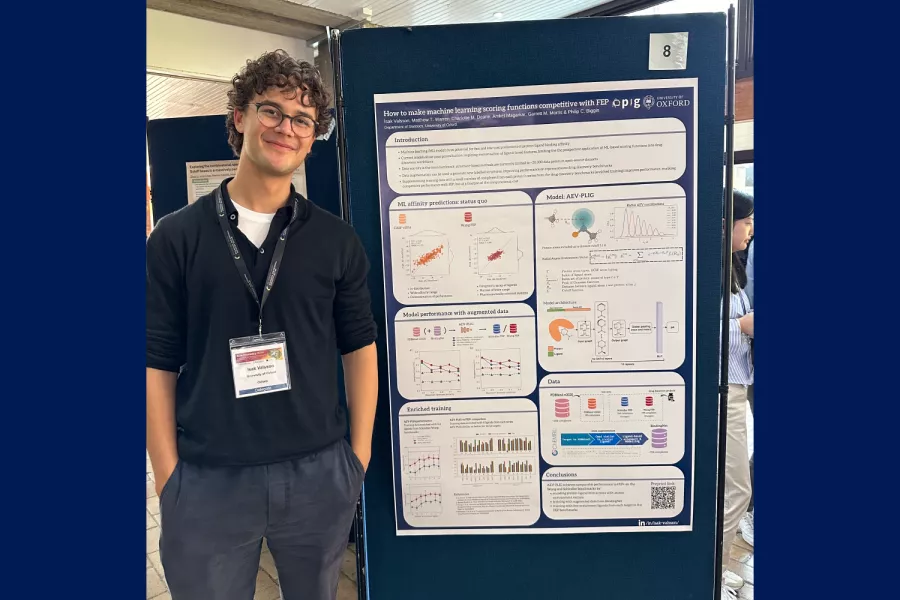
Congratulations to 2nd Year DPhil in Statistics student Ísak Valsson on winning the People’s Poster Prize at the RSC’s 7th "AI in Chemistry" symposium held at Churchill College, Cambridge 16th-18th September, 2024.

Research on AEV-PLIG
Ísak completed his MSc in Statistical Science under the supervision of Prof. Garrett M. Morris, developing AEV-PLIG which incorporates atomic environment vectors into protein-ligand interaction GNNs for binding affinity prediction. By predicting how tightly a small molecule will bind to a protein, we can computationally screen large numbers of molecules to find lead compounds faster and thus accelerate drug discovery.
Ísak continued his work on AEV-PLIG with Prof. Morris and Prof. Charlotte Deane in the Oxford Protein Informatics Group, successfully improving its accuracy and demonstrating its improved ability to generalize on a new “OOD Test” benchmark he has also developed.
In a collaboration with Prof. Philip Biggin in the Department of Biochemistry, Prof. Biggin's former postdoc Dr Matthew Warren, and Dr Aniket Anighoro at Boehringer Ingelheim, Ísak has shown AEV-PLIG is approaching the accuracy of much slower free energy perturbation methods which are widely used in pharma to predict differences in ΔG of binding for compounds in congeneric series of potential drugs. You can read more about the AEV-PLIG method on ChemRxiv ("How to make machine learning scoring functions competitive with FEP”, https://doi.org/10.26434/chemrxiv-2024-bth5z).
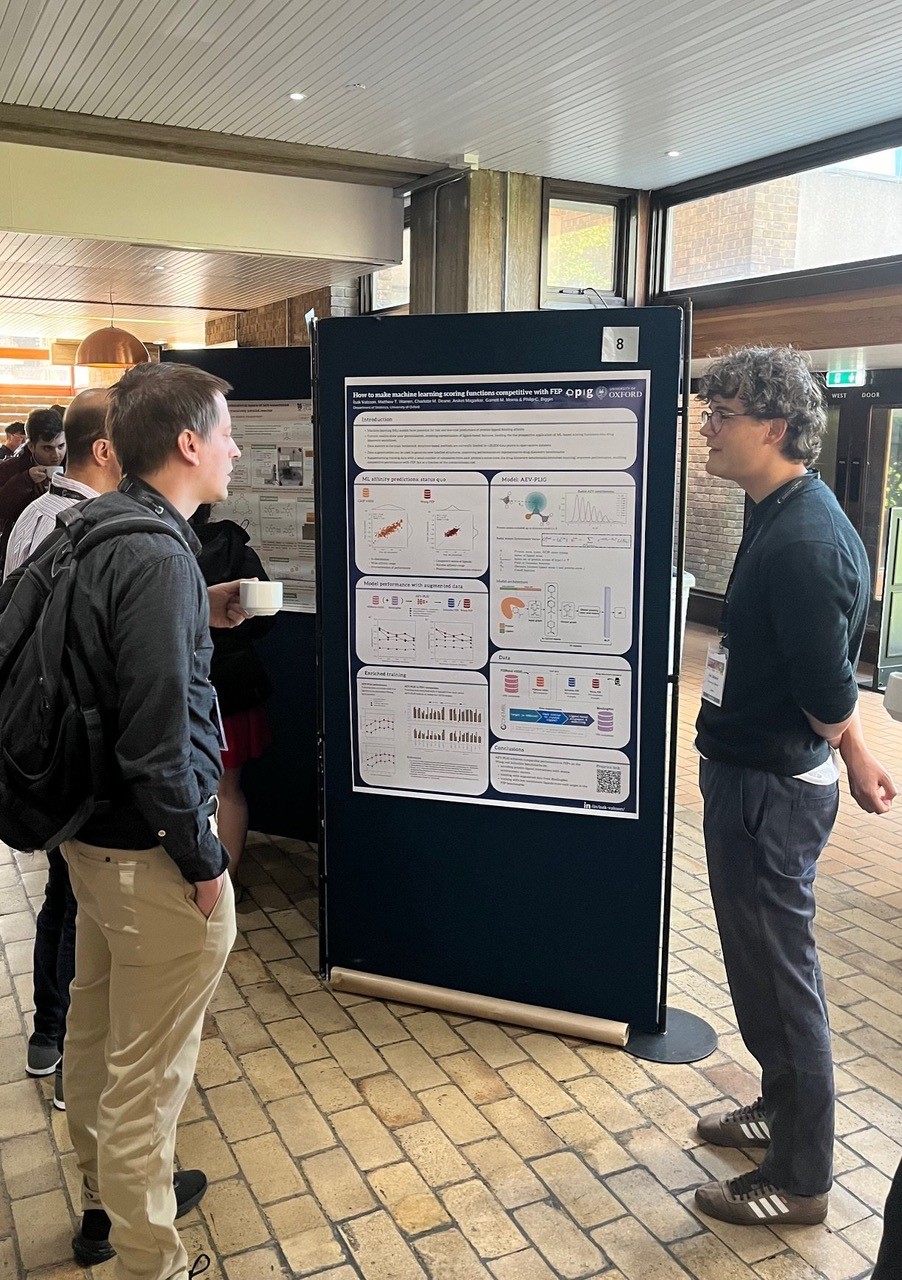
When presenting the award, Dr Swain commented that there had been a large number of very high-quality poster submissions and that People’s Prize was the most prestigious of the three awards.
Well done, Ísak!
-
Words and images provided by Professor Garrett Morris.
Applications for postgraduate study are now open for 2027–28 entry
Postgraduate study at Oxford Statistics offers the chance to work across a broad range of research, from statistical theory and methodology, probability and machine learning to applications in areas including genetics, epidemiology, computational biology, finance and the social sciences.
Tom Rainforth awarded full Professorial title
Tom Rainforth has been awarded the title of Professor of Statistical Machine Learning and, as of 1 September 2026, is also a Fellow of Jesus College.
What does a statistician do for the England football team?
From squad selection to modelling how footballs behave at altitude, statistician Matt Penn explains how data is helping shape the modern game, and why coaches will always matter more than the numbers.