
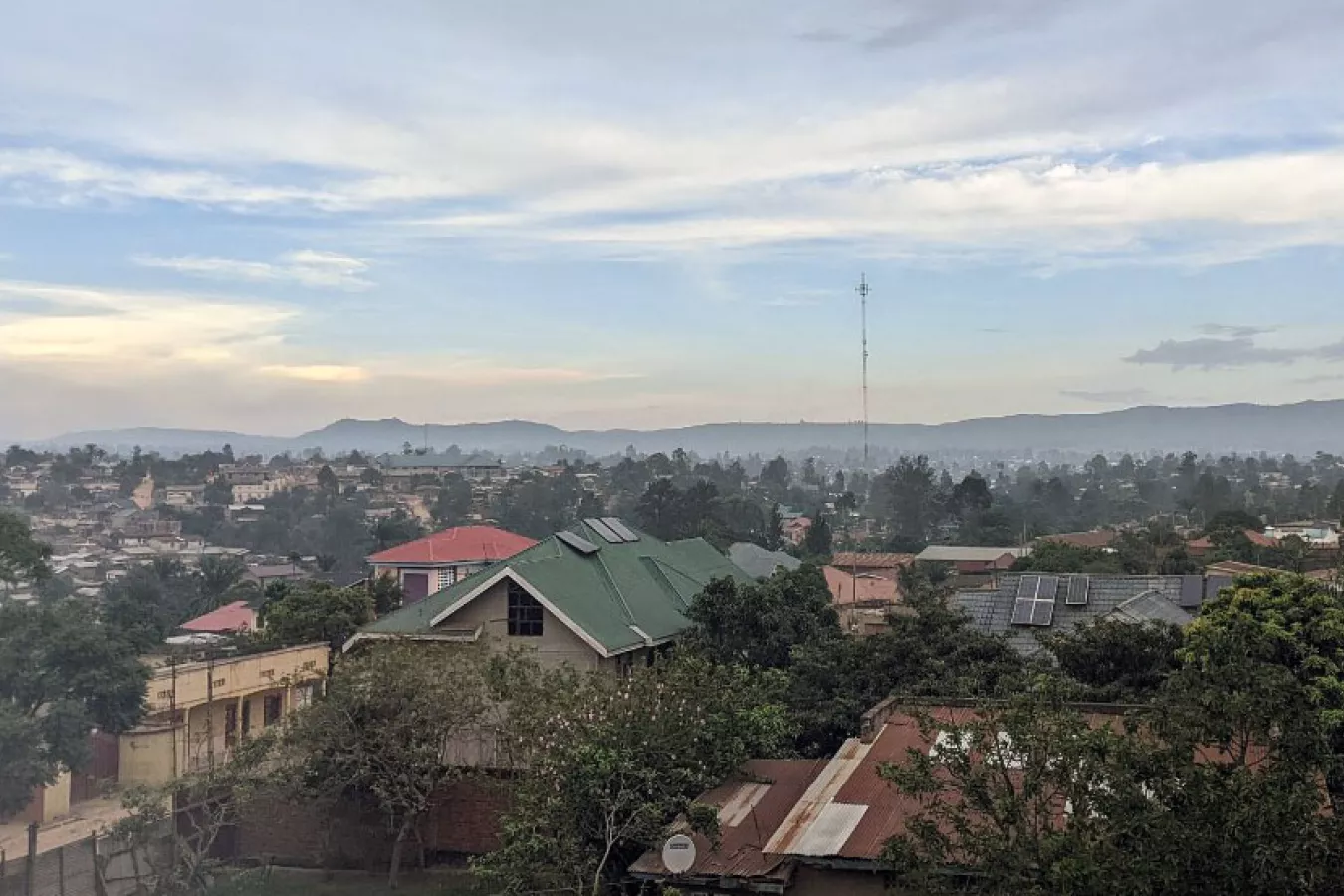
Researchers in the Department of Statistics show how assumptions about the way people travel can substantially change estimates of the size of an emerging disease outbreak.
In a recent study published in Nature Health, Dr Younjung Kim, Dr Cathal Mills and Professor Christl Donnelly examined estimates of Bundibugyo virus disease cases in the Democratic Republic of Congo (DRC) at the early stage of the epidemic.
Early in an outbreak, particularly in resource-limited settings, reliable case numbers can be difficult to obtain. One way to estimate the likely number of cases in an affected area is to use cases detected among people who have travelled elsewhere. Known as a ‘geographic spread’ approach, the method has previously been used to estimate the scale of outbreaks like H1N1 influenza in Mexico and COVID-19 in Wuhan, using cases detected among international air travellers. But what can be inferred from an exported case depends on how people actually travel.
Communities along the DRC–Uganda border are closely connected, with many people in these communities making short journeys between the two countries. Data on cross-border movements used in the study showed that more than 90% of trips to Uganda from Ituri and Nord Kivu lasted a week or less, and almost two-thirds were day trips.
Conventional geographic spread models assume that travellers stay away long enough to be detected at their destination. But at the DRC–Uganda border, someone infected in the DRC could cross into Uganda and return home before their infection is detected – distorting estimates of case numbers in the DRC. The researchers found that accounting for short journeys substantially changed both the estimates and the uncertainty around them.
A further consideration was the reason for travel. The cases detected in Uganda were not people who happened to become ill while away from home. All 15 cases imported and confirmed there by 21 June 2026 involved people from the DRC who had travelled specifically to seek medical care.
The conventional geographic spread approach assumes that infection does not affect a person's likelihood of travelling. But when infected people cross the border specifically to seek medical care, those cases cannot be considered equivalent to infections detected among ordinary travellers.
Lead author of the study, Dr Younjung Kim said: ‘Accounting for both the short journeys and why these cases travelled allowed us to better reflect the local context in our estimates.’
Once the researchers excluded cases involving travel specifically for healthcare, there were no remaining imported cases on which to base a central estimate. Instead, the analysis set a statistical ceiling on the likely number of cases in the DRC, helping inform response efforts during the uncertain early stages of an epidemic.
‘In epidemics we want there to be as few cases as possible, while learning as much as possible from the cases that do arise,’ said corresponding author Professor Christl Donnelly. ‘In my experience, the response works best with open communication between epidemiologists and public health policymakers. Understanding policy priorities focusses analyses on the questions that matter most.’
The researchers conclude that geographic spread methods can provide useful information early in an outbreak, but their reliability depends on understanding the real-world processes behind the data: who travels, for how long, and for what reason. While the method is “appealingly simple and intuitive,” the authors note that its usefulness relies on careful consideration of local context.
The research was supported by the National Institute for Health and Care Research and the Oxford Martin School Programme in Digital Pandemic Preparedness.
Read the full study in Nature Health: Cross-border travel patterns affect magnitude estimates for the Ebola Bundibugyo epidemic
Image: Ville de Bunia, Commune Nyakasanza by Vinny Kitenge, licensed under CC BY-SA 4.0, via Wikimedia Commons. Cropped from original.

Alison Etheridge awarded the 2027 Ulf Grenander Prize
The American Mathematical Society has recognised Professor Dame Alison Etheridge for work linking probability theory and population genetics.
Statistics researchers join £1 million programme to investigate immune ageing
Researchers from the University of Oxford's Department of Statistics will help investigate how the immune system changes with age, as part of a new £1 million interdisciplinary research programme funded by the Oxford Martin School.
Professor Robin Evans
The Department of Statistics is deeply saddened to announce the death of Professor Robin Evans on 3 November 2026, following an illness.